Stepping up from a standard 1,500-word essay to a 5,000-word research project feels like moving from a light jog to a full marathon. For many undergraduate students, the sheer volume of pages required can lead to “word-count anxiety,” where the focus shifts from quality research to simply hitting a number. However, long-form writing is actually a golden opportunity to showcase deep critical thinking and a sophisticated grasp of your subject matter.
Managing such an extensive project requires a shift in strategy. Instead of seeing it as one giant wall of text, you must view it as a series of interconnected arguments. To navigate this successfully, you need a clear roadmap. Learning how to write a 5000 Word Essay involves breaking the task into manageable “micro-essays,” ensuring that each section serves a specific purpose without repeating points made earlier. When you approach the task with this structural mindset, the word count becomes a byproduct of your analysis rather than a looming threat.
The Foundation: Why Structure is Your Best Friend
A 5,000-word paper is too long to “wing it.” Without a robust outline, you will likely find yourself drifting off-topic by page six. Experts suggest a “modular” approach where you allocate specific word counts to your introduction, literature review, methodology, core arguments, and conclusion. This prevents you from spending 3,000 words on the background only to realize you have no space left for your actual analysis.
Planning Your Word Count Distribution
To keep your writing balanced, it helps to visualize how your 5,000 words should be distributed across the paper. Below is a standard breakdown used by many high-achieving undergraduates globally:
| Essay Section | Purpose | Suggested Word Count |
| Introduction | Define the thesis and scope. | 500 words |
| Literature Review | Analyze existing research. | 1,000 – 1,200 words |
| Methodology | Explain how you gathered data. | 500 – 700 words |
| Main Analysis | Your core arguments and evidence. | 2,000 words |
| Discussion | Implications of your findings. | 500 words |
| Conclusion | Summary and final thoughts. | 300 – 500 words |
Diving Deep into the Literature Review
The literature review is often the meat of a long-form essay. It isn’t just a list of who said what; it’s a conversation. You are looking for “gaps” in the current knowledge where your essay can fit in. In a 5,000-word piece, you have the luxury of exploring niche theories and dissenting voices that a shorter essay would have to ignore. This depth is exactly what professors look for when grading for “Expertise and Authoritativeness.”
Maintaining a Consistent Voice
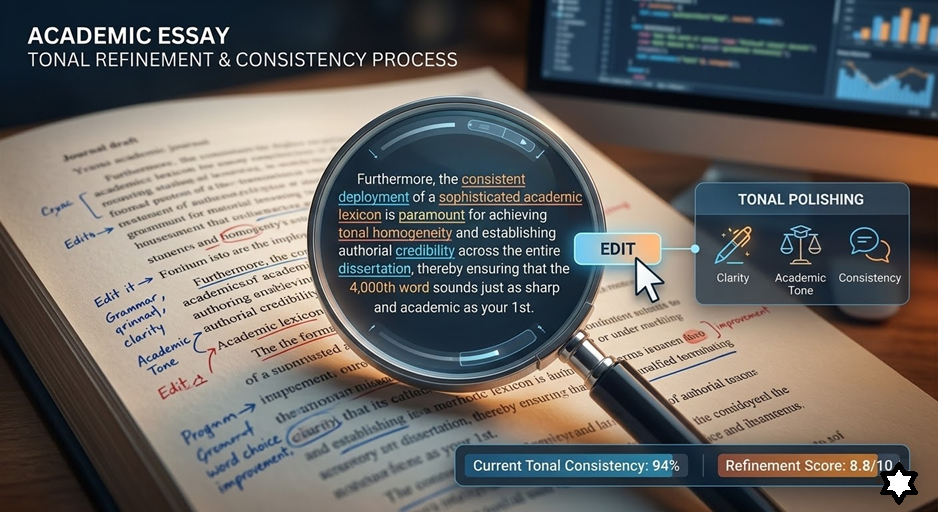
One of the biggest challenges in long projects is “tonal drift.” You might start on Monday feeling academic and professional, but by Friday’s late-night session, your writing might become informal or weary. To combat this, always read your previous day’s work before starting a new section. This keeps the “vibe” of the paper consistent.
If you find that your sentences are becoming clunky or your vocabulary is getting repetitive after hours of typing, don’t panic. Many students use the Myassignmenthelp essay rewriter to help refresh their perspective and find more elegant ways to transition between complex ideas. Using such tools during the editing phase ensures that your 4,000th word sounds just as sharp and academic as your 1st.
The Importance of “Signposting”
In a long essay, the reader can easily get lost. Signposting is the art of telling the reader where you are and where you are going. Phrases like “Having examined the economic impact, we must now turn to the social implications…” act as breadcrumbs. They link your paragraphs together, ensuring that the 5,000 words feel like a unified journey rather than a collection of random thoughts.
Evidence, Not Just Opinion
In undergraduate writing, every claim needs a backbone. For a project of this scale, aim for a high “citation density.” This doesn’t mean every sentence needs a footnote, but every major point should be backed by a peer-reviewed source, a case study, or a primary data point. This builds the “Trustworthiness” that Google and academic examiners value so highly.
Managing the “Middle-Muddle”
Around the 3,000-word mark, most students hit a wall. This is the “middle-muddle” where the finish line feels far away and the introduction feels like a lifetime ago. The trick here is to switch tasks. If you can’t write the analysis right now, work on your bibliography or format your tables. Keeping the momentum alive is more important than being perfectly chronological.
The Final Polish: Editing for Impact
Never submit a 5,000-word draft the moment you hit the word count. A long essay requires at least two days of cooling off before the final edit. When you return with fresh eyes, look for:
- Redundancy: Did you say the same thing in the intro and the third chapter?
- Paragraph Length: Are your paragraphs too long? (Aim for 150-250 words each for better readability).
- Flow: Do the transitions between sections feel natural?
Frequently Asked Questions (FAQ)
1. Is 5,000 words too much for an undergraduate essay?
It is certainly at the higher end of the spectrum, usually reserved for final-year dissertations or capstone projects. However, with a proper outline, it is entirely manageable.
2. How many sources should I use for a 5,000-word paper?
A good rule of thumb is 1 to 2 unique sources for every 500 words. For a 5,000-word essay, aiming for 15–25 high-quality sources is standard.
3. How do I avoid “fluff” when trying to reach the word count?
Instead of using more words to say the same thing, use the space to provide more examples, explore a counter-argument, or dive deeper into the methodology.
4. Can I use AI tools to help me write?
While AI can help with brainstorming, academic integrity is paramount. Use specialized tools like those from Myassignmenthelp to refine your own original thoughts rather than generating content from scratch.
5. What is the best way to format such a long document?
Use clear headings (H1, H2, H3) and a Table of Contents. This makes the document “scannable” for both your professor and search engines like Google.
About the Author
I’m Ethan Martin, a Senior Academic Consultant and content strategist associated with MyAssignmentHelp. With over a decade of experience in the higher education sector, my mission is to bridge the gap between complex academic requirements and student success.My work focuses on helping undergraduate and postgraduate students navigate the rigors of long-form research, specialized case studies, and advanced dissertation planning.